

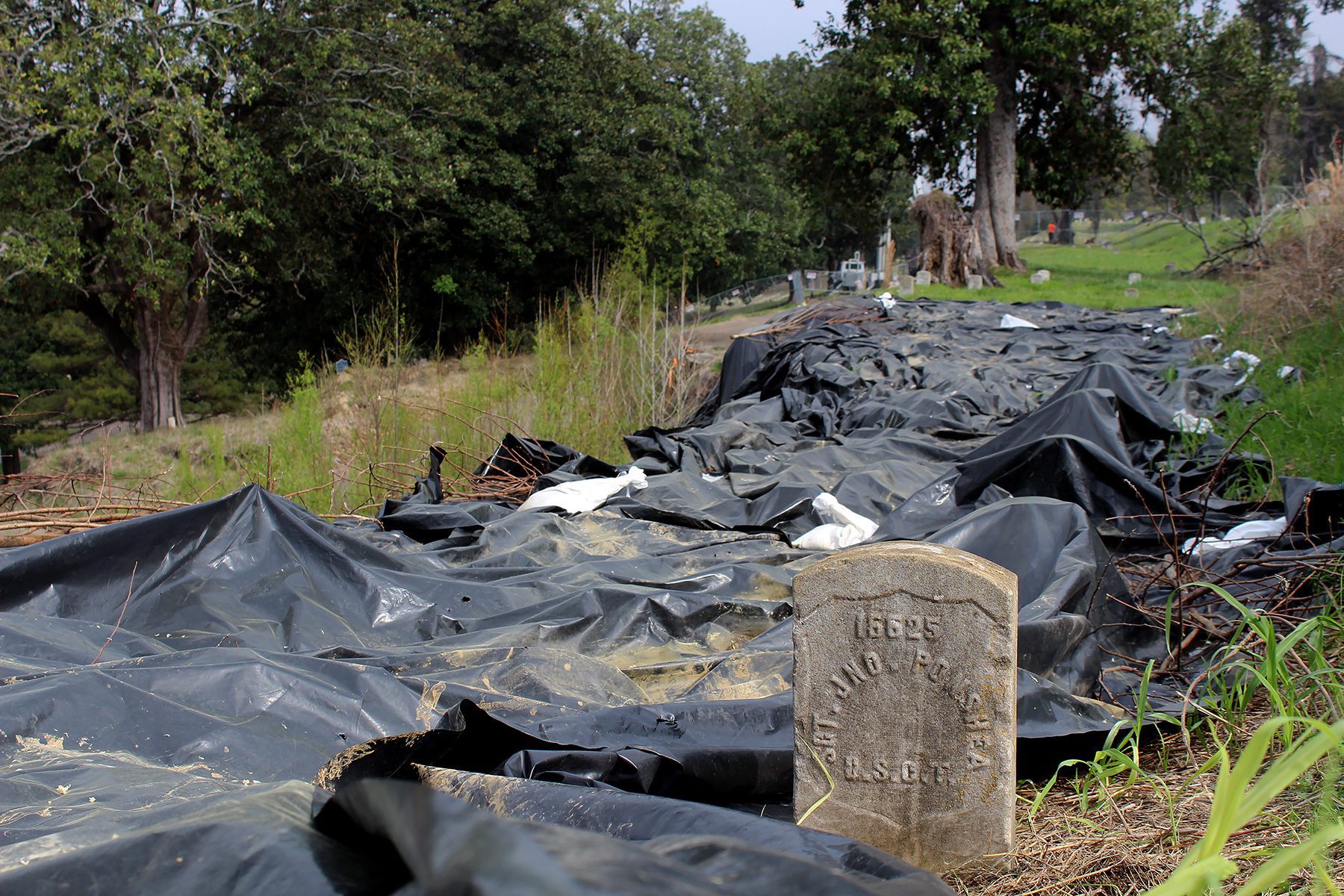
From tragedy can spring hope. And so, it was when a terraced section of Vicksburg National Cemetery collapsed due to heavy rains and landslides in early 2020.
The landslides displaced and damaged dozens of burials in Section T and covered more in Section J, both of which were designated burial sections reserved for United States Colored Troops (USCT) that served with distinction in the Civil War.
Over the course of nearly two years, Chronicle Heritage excavated the remains of at least 106 individuals in the landslide area. A careful analysis of the remains has resulted in the creation of one of the world’s largest bioarchaeological databases for the Civil War and has enabled our team to reconstruct the stories of the USCT who fought, died and were buried in Mississippi.
According to Bennie J. McRae, author, historian, and black Civil War expert, some of the USCT buried at Vicksburg were killed during the Siege of Vicksburg, while many more died on neighboring battlefields following the siege.
“A Duty of Care”
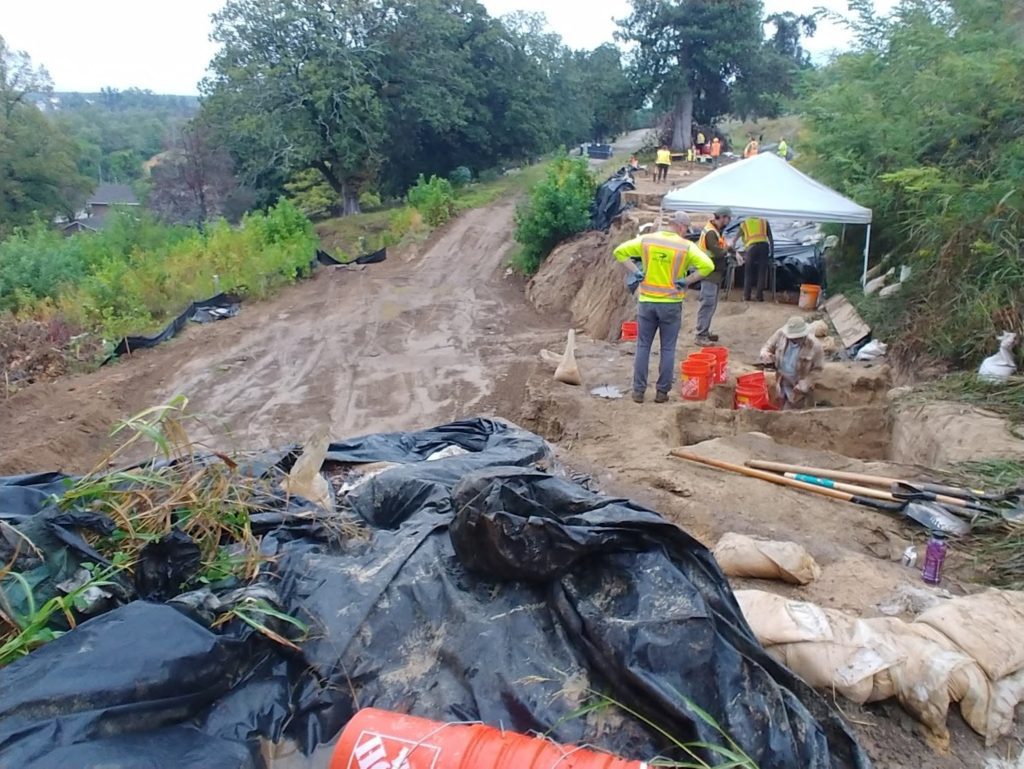
As principal investigator for the project, Brad Lanning, Senior Archaeologist at Chronicle Heritage, understood the responsibility given to his team and the importance of its meticulous bioarcheological work.
“Certainly, you feel the weight of the responsibility to care for these remains to the best of your ability, and to execute the excavation in a way that is scientifically defensible and complete,” he said. “We have a duty of care to the descendants, to the living. To tell the stories of these people that lived and died in that area makes a difference and matters to the people that are here right now.”
Working against the typical cultural resource management constraints of time, budget and environmental factors, Lanning and his team set out to get the maximum amount of data they could reasonably record for the database.
“What do we need in order to get the maximum amount of data? We do that by following well established standards,” Lanning said. “We do that by taking measurements of everything we can. All of the postcranial and craniometrics, the dental measurements, things of that nature in order to be able to estimate sex, ancestry, stature.”
Hard Lives Lived
Much of the team’s bioarcheological analysis became focused on the pathologies of the USCT.
“These were people that lived hard lives,” said Lanning. “The pathologies that we saw, those were things that you would expect of people doing hard labor. There were divots on muscle attachment points that you only get when undergoing extreme strain and stress on your muscles for an extended period. It’s what we call an enthesopathy. You get those when you are doing heavy labor all the time. We also saw healed fractures, things of that nature, things that you would get from doing hard labor every single day.”
The analysis offered the team a glimpse into the slavery system of Civil War-era America, and its profound physical impact on those burdened by slavery.
“What we saw and what we were recording was the physical record of the brutality of the chattel slavery system in the American South,” said Lanning. “It was the strict racial hierarchy and brutality of that system made manifest on their bones.”
As more instances of enthesopathies were recorded, Lanning and his team’s sense of responsibility for the remains only deepened.
“We were seeing the effects of slavery and of conditions in the country for Black Americans, on their bones,” said Lanning. “That was what required a lot of due diligence to record as completely as possible in order to provide a full record of their lived experiences.”
Spread the Knowledge
Now that Chronicle Heritage has completed the bioarcheological database assemblage, the company hopes that the database will be published with open access.
“Our recommendation will be to publish it and allow other researchers to have access to it to conduct further research,” said Lanning.
The database was created based on Chronicle Heritage’s contract with the National Park Service.
“Through the terms of the contract, we provide them the data,” said Lanning. “What they ultimately decide to do from it from that point going forward will be up to them. We can make recommendations and have made recommendations that the data would be published and made available for other people to research, because it is one of the largest skeletal assemblages of USCT available.”
A Massive Undertaking
On first sight, Lanning described the landslide area as “a little overwhelming”
Following rounds of heavy rain in early 2020, the cemetery’s Section T terrace collapsed and crumbled downward, burying portions of Section J below it which also contained Civil War era burials. The landslide split Cemetery Loop Road, a paved road that winds through the cemetery, in half.
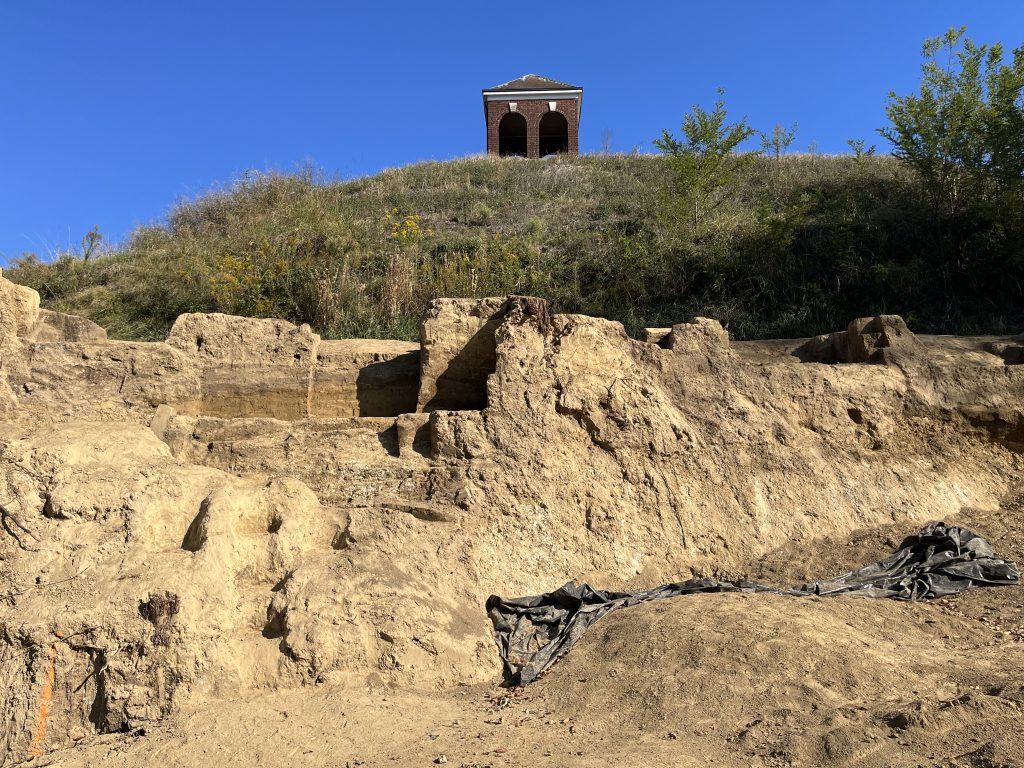
“There was just this massive vertical cliff face,” said Lanning. “It was around 14 feet tall between where you were standing at the base of the collapse versus where the terrace originally was. Just the sheer size of it was remarkable to see. And then, you’d look down the hill and see all the soil that had shifted and moved downwards. The whole hillside just slid sideways.”
Lanning and his team decided to work from the top down.
“The entire base of the scarp was full of erosional deposits, which means it was full of bones. That was going to be a challenge,” he said. “So, we went up to the top of the terrace, the intact portion of the terrace, and we started from the north end and from the south end of the impacted portion and worked towards the middle. Then we worked from the base of the mound out towards the edge of the scarp where it was the least stable and got the impacted and at-risk burials out.”
Work on top of the terrace complete, Lanning and his team then moved to the collapsed portion of Section T.
“Once the intact portion of the Section T terrace was complete, we went back and dug the base of the scarp and mechanically stripped it out to make sure we got all the remains out of the collapsed portion,” he said. “And then, at that point, we relocated down the hill and pulled all of the redeposited dirt off of Section J, which is at the base of the hill.”
There was quite a lot of recovery work needed below in Section J, so the team called in an excavator.
“We exposed all of the headstones that had been covered by the landslide and then stripped down to expose the grave shafts there,” Lanning said. “And then once those grave shafts were exposed, then we would dig those out by hand. But, really, most of the Section J work was done with the mechanical excavator just because of the amount of overburden that had been deposited on top of that original terrace surface.”
Lanning said that, on a given day, anywhere between five and 15 Chronicle Heritage archaeologists worked on the site.
Finding Hope in Tragedy
Much like the Civil War itself, Lanning can find hope in the tragedy of the Vicksburg National Cemetery landslides.
“If it had not been for the landslides, we would not be doing the work,” he said. “There would be no analysis. There would be no excavation. There would be no understanding.”
To Lanning, it all comes back to the descendants of those that made the ultimate sacrifice for their country.
“We always need to keep in mind that these were people, and they matter. They matter. Remains matter. They’ve always mattered,” he said. “I don’t want us to forget that these were people and that they matter to somebody.”
(Photos and cutlines courtesy of NPS)