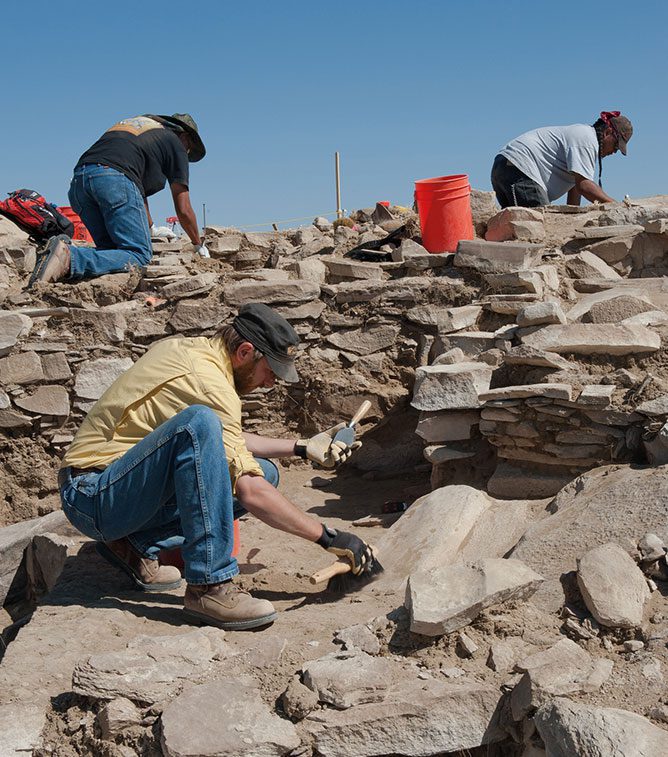

Archaeology
FAST, THOROUGH, AND CULTURALLY SENSITIVE ARCHAEOLOGY

De-risk your infrastructure or development project and achieve a better bottom line with Chronicle Heritage cultural resources and archaeological services.
Specializing in cultural resources compliance, our team conducts surveys, evaluations, and inventories. We have completed more than 800 Phase I, II, and III surveys across all 50 states, as well as in the Caribbean, the UK and Europe, and the Middle East and Asia. This experience has awarded us some of the most complex cultural resources projects in the world.
With Chronicle, it’s possible to celebrate and preserve cultural resources while delivering projects ahead of schedule, providing exceptional service and developing practical solutions that support successful implementation.
We are a cross-functional team of experts who love history, heritage, and solving problems. We use multifaceted technology to lower costs, and we manage nuanced projects and aggressive timelines. Our network transcends industries, communities, and regulatory bodies.
We have conducted cultural resources surveys for major land use and multi-state infrastructure projects, including the UNEV Pipeline Project and the Palen Solar Project.
Cultural Resources Evaluations and Inventories
Chronicle provides cultural resources evaluations to determine the existence, and establish the significance of any cultural resources on your project site.
Once we find something of significance, we then create cultural resources inventories to document what we find.
Cultural resources evaluation activities include:
- Desk-based assessment of existing records, maps, and reports to gain an understanding of the site’s history and potential cultural significance.
- Geophysical surveys using noninvasive techniques such as ground-penetrating radar, magnetometry, and resistivity to detect and map subsurface features without excavating.
- Trial trenching to test the potential for any remains and to assess the depth, extent, and preservation of these remains before committing to a full excavation.
- Environmental sampling to analyze the site for evidence of past human activity.
Backed by comprehensive expertise in federal, state, and local regulations, our team delivers strategic recommendations that support project success.
Cultural Resources Surveys
Chronicle provides cultural resources surveys that identify and document cultural and biological resources so you can stabilize your development project before you break ground.
Phase I, II, and III surveys refer to successive levels of archaeological investigation, primarily under Section 106 compliance, state regulations, and environmental review processes.
Phase I: Identification Survey
A Phase I cultural resources survey establishes whether archaeological resources are present within a proposed project area and whether they may affect permitting, compliance, or project design. Our archaeologists review existing records, historical documents, and previous investigations before conducting pedestrian surveys and subsurface testing in the field. The goal is to identify potential constraints early, giving your project team the information needed to assess risk, support permitting, and make informed planning decisions before construction begins.
Phase II: Evaluation
When Phase I identifies archaeological resources, we conduct a Phase II evaluation to determine whether those resources are significant under applicable regulatory criteria. This involves controlled excavation, expanded testing, artifact analysis, and site boundary delineation. Our archaeologists assess a site’s integrity, age, and research potential, and evaluate its eligibility for listing in the National Register of Historic Places. These results give your project team a clear picture of whether a resource represents a permitting constraint, and what options may be available: avoidance, design modification, or mitigation.
Phase III: Data Recovery and Mitigation
When a significant archaeological site cannot reasonably be avoided, we conduct a Phase III data recovery to preserve the knowledge it contains before project impacts occur. This involves large-scale excavation, documentation, laboratory analysis, and artifact curation in accordance with regulatory requirements. For project proponents, Phase III typically represents the final compliance step, allowing development to proceed once agreed mitigation measures are complete.
Archaeological Compliance Monitoring
Chronicle provides archaeological compliance monitoring services to observe and document the cultural and heritage resource management activities on your project site.
Archaeological compliance monitoring is usually required for land development projects across every stage of the project life cycle, and we can help. Not only do we have strong working relationships with regulatory bodies, we understand the impact and requirement of regulations on a project’s day-to-day operations. No one wants penalties or delays for noncompliance. We’ll identify the problems before their impact becomes irreversible and costly, and we report on time to keep your project moving forward.
Cultural Resource and Heritage Management Solutions for Major Projects
Challenging projects enliven us – so bring us your project headache. We’ll partner with you all the way. And, we’ll start by bundling our services so you meet your milestones efficiently.
Navajo-Gallup Water Supply Cultural Resource Project